
Background: I commented: "the silver chart appears to have been painted to make it look like we were hitting a manic blow-off top phase in April. "
To which KD fairly noted: "I'm surprised to see GM Jenkins use the term "painted" to describe the April action - the April action was a result of mania. There's no doubt about that."
Ok, by "painted" I mean "not actively suppressed." In other words, my provisional view is that the status quo is interference in these markets, such that without interference the natural state of the PM markets right now would resemble a nuclear reactor with a busted heat exchanger: any given trigger would easily shoot prices literally to the moon (as in you'd have to literally visit the moon to retrieve them). Of course, I by no means feign certainty in these matters, and am willing to defer to argument or even trustworthy authority.
But, my reasoning is as follows: the same way that a government has to have measures in place to preserve the status quo, such as, say, proactive and reactive protocols to prevent cyber-attacks or electrical-grid failures, so (the intrinsic value of paper being zero), it needs to have in place active measures to prevent a loss of faith (rational or irrational) in its currency. Obviously, this is especially true when a loss of faith is indeed eminently rational, since the future sure ain't what it used to be (21st century America, and really the Western world as a whole, is the 19th century Ottoman Empire: the sick man of the globe).
My next premise: I believe (cf. Marty Armstrong) that the fiat price of gold in a fiat world is a straight function of faith in the competence and integrity of the ruling class, and by extension of future stability and positive quality of life. So, connecting the dots, I think it's far more likely than not that the ruling class cares more that a mania in gold not occur than even that a city isn't destroyed by terrorist attack. Sure, they'd rather not see any commodity -- corn or cattle -- go up in price, but they're scared unto death that the price of gold will skyrocket like LinkedIn stock. (To a lesser extent, they're similarly worried about oil, but for different reasons.)
So we have a motive, and all that's left is means. I don't know what to believe about the various theories of price suppression that I've read, e.g. via GATA, and I enjoy reading debunkings (including KD's) of various claims thereof. However, can KD or anyone really argue that, beyond any reasonable doubt, government has neither motive nor means here? How does one explain that the number of times gold, the best asset class of the decade, has gone up by more than 1% in a day has been a 3 standard deviation event?
I extend the above reasoning to silver, since it's been money for longer than gold has, except that it's much easier to manipulate because the market is so small. Whereas the gold:silver ratio obviously fluctuates, it's historically never gone up by more than an order of magnitude, so keeping silver cheap, combined with some mechanism in place also to control gold, ipso facto reins in gold and preserves the status quo. I certainly can't be the only one who realizes this.
Then there's a preponderance of little points of evidence, too. For example, there's Andrew Maguire's testimony and the many consequent lawsuits that have not been summarily dismissed (including some, I believe, against even SLV), and the lame foot-dragging of the CFTC. There's the simple fact that the spokespeople of TPTB were wildly bullish in their economic forecasts through the 2000's and thus lost all credibility, while team GATA and their Austrian satellites have been consistently right in their predictions, so I give them the benefit of the doubt more now than I would have if I had heard of them in say, 1999. GATA certainly presents ample points of evidence, such as those marshaled in a recent speech by Chris Powell, which I strongly encourage everyone to read.
Then, since we're talking about silver 2011, there are the curious circumstances immediately preceding the so-called bursting of the bubble. I noted here (posted while silver was still > $40) that, coinciding with the conspicuous absence in April 2011 of the typical waterfall drops in silver, there was also an absolute, unprecedented disconnect between the silver price and the mining shares. I'm not talking about mere "underperformance" here. Here's my chart in that post.

Luckily, stockcharts.com now has a "correlation coefficient" feature, so I took a look at it for the duration of silver's ascent through May 2. My suspicions were correct:
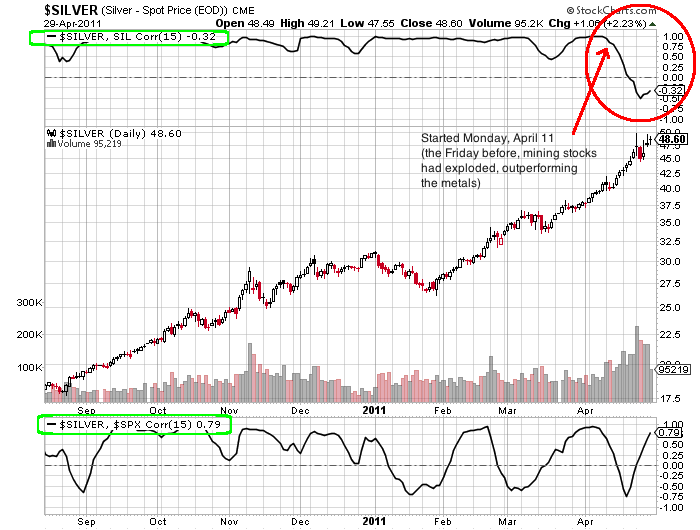
A negative correlation! Some mania! It's as if internet sales exploded in January 2000 while the internet companies' stocks fell.
To be sure, not every explanation for this April 2011 phenomenon supports my position, but I think the best ones do. As I wrote in the above post: "Someone knows something. Caveat emptor." Note that if silver stocks had exploded along with silver itself, the general public might have joined the small circle of silverbugs in their mania, so were they capped? Or were certain parties with inside information of future events heavily selling them short for profit? Why were the bullion banks covering shorts during the bursting of the bubble and not selling into it? Moreover, Occam's razor says that the curious timing of the first raid on silver was no coincidence: zero economic news, access markets on a Sunday night, Asian holiday, right before a chain of several margin hikes (why not one or two big ones? then, why not raise margins once silver settled down?), a few hours before the Osama bin Laden announcement, etc. It should also be noted that on that otherwise quiet evening, gold had just made an all-time high when markets opened.
